
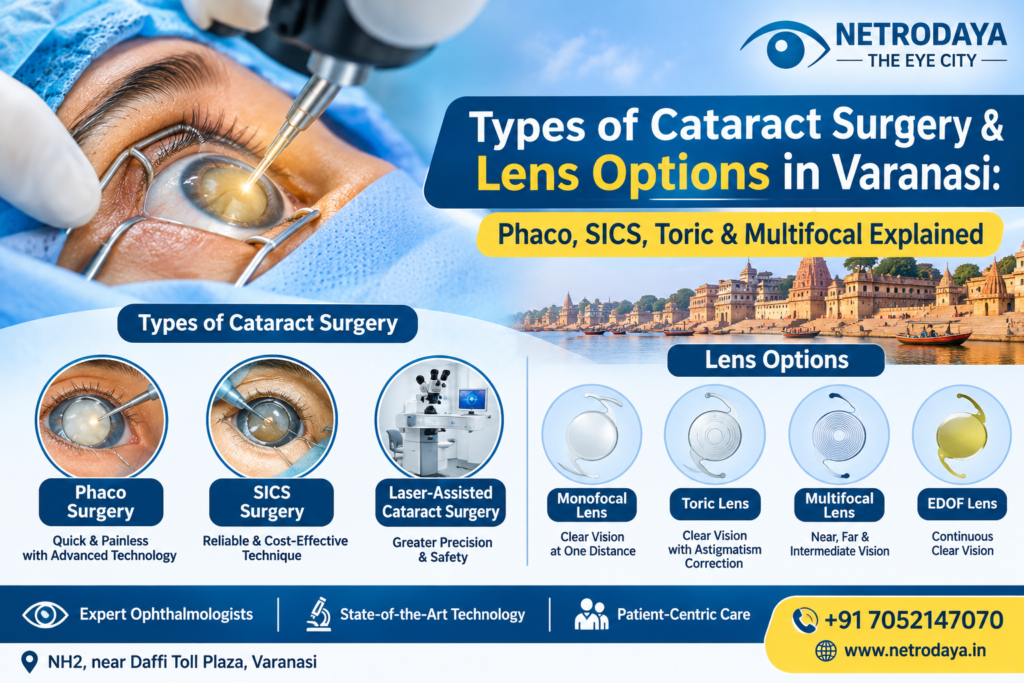
Types of Cataract Surgery & Lens Options in Varanasi: Phaco, SICS, Toric & Multifocal Explained
Modern cataract surgery replaces your cloudy natural lens with a clear artificial lens (IOL), and the two choices that shape your result are the surgical technique and the type of lens. Understanding both before your operation helps you get the vision that suits your daily life.
If you or a parent has been told “motiyabind ka operation karwana padega“, you probably have many questions. Which surgery is best? Which lens should I choose? Will I still need glasses? This guide from Netrodaya The Eye City, a NABH-accredited and CGHS-empanelled eye hospital on NH2 near Daffi Toll Plaza, Varanasi, answers them in simple language.
Types of cataract surgery available in Varanasi
All modern cataract operations remove the cloudy lens and place a new one. They differ in the size of the opening and the method used to remove the cataract.
| Technique | How it works | Best suited for |
| Phacoemulsification (phaco) | A 2–3 mm opening; ultrasound breaks the cataract into tiny pieces; a foldable lens is placed. No stitches. | Most patients; fastest visual recovery |
| Micro-incision phaco (MICS) | Same principle as phaco with an even smaller opening, often under 2 mm | Patients wanting minimal post-operative astigmatism |
| SICS (manual small incision) | The cataract is removed whole through a slightly larger, self-sealing tunnel | Very mature or hard cataracts |
For most people, phaco cataract surgery is the gold standard. It takes about 15–20 minutes, is done under numbing drops or a local block, and allows same-day discharge.
Which cataract lens (IOL) is right for you?
Choosing the intraocular lens is a lifestyle decision as much as a medical one. Your surgeon will advise based on your eye measurements, but this table shows how each lens type performs.
| Lens type | Vision after surgery | Glasses needed? | Who should consider it |
| Monofocal | Sharp at one distance, usually far | Yes, for reading | Most patients |
| Toric | Corrects astigmatism plus one distance | Usually for reading | Cylinder power of about 1.0 D or more |
| Multifocal / trifocal | Far, intermediate and near | Rarely | Readers, professionals and active seniors with healthy retinas |
| EDOF (extended depth of focus) | Far and computer/phone distance | Sometimes for fine print | Those who want fewer halos than multifocal lenses |
How your surgeon decides the right surgery and lens
Two patients of the same age may need very different plans. At Netrodaya, these factors guide the recommendation:
- Precise eye measurements. Biometry and keratometry calculate the exact lens power and detect astigmatism.
- Hardness of the cataract. A very mature cataract may be better suited to SICS or special phaco techniques.
- Retina health. Diabetic retinopathy or macular degeneration can limit the benefit of multifocal lenses, so an OCT scan may be done first.
- Glaucoma. Eye pressure and optic nerve health may change the surgical plan or call for combined surgery.
- Your lifestyle. Reading, driving, computer work and hobbies all influence which lens will make you happiest.
- General health. Blood sugar and blood pressure should be under control before the operation.
Because Netrodaya has glaucoma, surgical retina and oculoplasty specialists in the same hospital, complex eyes are assessed by the right expert before surgery, without referrals elsewhere.
Cataract surgery under CGHS and health insurance
Netrodaya The Eye City is a CGHS-empanelled eye centre in Varanasi. Serving and retired central government employees can have their cataract surgery here with a referral from their CGHS wellness centre.
Most health insurance policies also cover cataract surgery after the policy’s waiting period. Carry your CGHS card or insurance policy, photo ID and any previous eye reports to your first consultation, and our help desk will guide you through the paperwork.
Why patients across Purvanchal choose Netrodaya for cataract surgery
- NABH accreditation: independently audited standards for sterilisation, patient safety and operation theatre protocols.
- Sub-specialists under one roof: cataract, glaucoma, surgical retina, oculoplasty and orbit surgery teams work together.
- 24×7 eye emergency and in-house anaesthesiology: an added safety net for elderly and high-risk patients.
- Easy to reach: on NH2 near Daffi Toll Plaza, with simple access from Lanka, BHU, Sunderpur, Ramnagar, Mughalsarai (DDU Nagar), Chandauli and Mirzapur.
- Experienced surgeons: Meet renowned Cataract Eye Surgeons like Dr Abhishek Chandra, having experience more than 20 year. Also, We have Dr Goving V Khalkho, Dr Neha Shilpy and many more.
Questions to ask before your cataract surgery
- Which surgical technique do you recommend for my eye, and why?
- Which lens type suits my eyes and lifestyle?
- Will I need glasses for reading or driving afterwards?
- Who will perform my surgery, and how experienced are they?
- How many follow-up visits will I need?
Frequently asked questions
1. Which is better: phaco or SICS cataract surgery?
Phaco gives faster recovery and needs no stitches, so it suits most patients. SICS remains an excellent option for very hard or mature cataracts. Your surgeon recommends the safer choice for your eye.
2. Which is the best lens for cataract surgery?
There is no single best lens. Monofocal lenses give excellent distance vision, toric lenses correct astigmatism, and multifocal or trifocal lenses reduce dependence on glasses. The right lens depends on your eye health and lifestyle.
3. Can I be glasses-free after cataract surgery?
Many patients who choose multifocal, trifocal or EDOF lenses rarely need glasses. Those with monofocal lenses usually need reading glasses.
4. Does the new lens ever need to be replaced?
No. The intraocular lens is designed to last a lifetime.
5. Can cataract be treated without surgery?
No. Eye drops, diets or home remedies cannot clear a cataract. Surgery is the only effective treatment.
6. How long does cataract surgery take?
The operation takes about 15–20 minutes, and most patients go home the same day.
7. Is cataract surgery available under CGHS at Netrodaya?
Yes. Netrodaya The Eye City is CGHS-empanelled. Bring a referral from your CGHS wellness centre.
Book your cataract consultation in Varanasi
The right technique and the right lens make all the difference to how you see for the rest of your life. Get a complete cataract evaluation and a personalised lens recommendation at Netrodaya The Eye City, NH2, near Daffi Toll Plaza, Varanasi.
Note: This article is for general information only and is not a substitute for a medical consultation.