
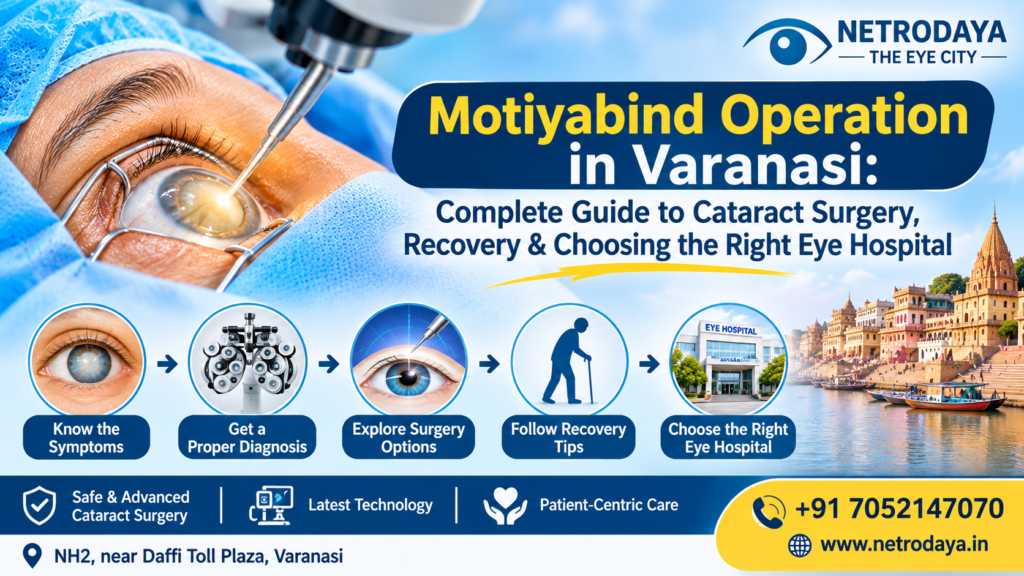
Motiyabind Operation in Varanasi: Complete Guide to Cataract Surgery, Recovery & Choosing the Right Eye Hospital
Cataract surgery is a 15–20 minute, stitch-free procedure that replaces your clouded natural lens with a clear artificial one, and most patients go home the same day. It is one of the safest and most successful operations in medicine, and the only proven treatment for cataract (motiyabind).
Yet many families in Varanasi and Purvanchal delay it for years, out of fear or because “abhi to dikh raha hai.” This guide from the cataract team at Netrodaya The Eye City, a NABH-accredited eye hospital on NH2 near Daffi Toll Plaza, walks you through the signs, the procedure, recovery, and how to pick the right hospital.
Signs it may be time for a motiyabind operation
A cataract develops slowly, so changes are easy to miss. See an eye specialist if you notice any of these:
- Blurred, cloudy or “smoky” vision that glasses no longer fix
- Glare or halos around headlights, making night driving difficult
- Colours looking faded or yellowish
- Frequent changes in spectacle power
- Double vision in one eye
- Difficulty reading, recognising faces or watching TV
You do not need to wait for a cataract to “ripen” (pakna). Modern phaco surgery works best when the cataract is not yet hard, so early surgery usually means a smoother operation and faster recovery. Eye drops, diets or home remedies cannot dissolve a cataract.
How phaco cataract surgery is done: step by step
At Netrodaya, most cataract operations use phacoemulsification (phaco), the global standard. Here is what happens on the day.
- Pre-surgery check and measurement. A few days before, your eye is measured (biometry) to calculate the exact power of your new lens. Blood sugar and blood pressure are checked.
- Numbing the eye. Anaesthetic drops or a small local injection make the eye completely numb. You stay awake but feel no pain.
- A tiny incision. The surgeon makes a 2–3 mm opening at the edge of the cornea. No stitches are needed.
- Removing the cataract. An ultrasound probe breaks the cloudy lens into tiny pieces and gently removes them.
- Placing the new lens. A foldable intraocular lens (IOL) is inserted through the same opening, where it unfolds and stays for life.
- Going home. After a short rest and check-up, you go home the same day with protective glasses and eye drops.
Recovery after cataract surgery: a week-by-week timeline
Most people see more clearly within a day or two, and return to routine activities within a week.
| Time after surgery | What to expect | What to do |
| Day 1 | Mild grittiness, watering, slightly hazy vision | First check-up; start drops exactly as prescribed |
| Days 2–7 | Vision clears steadily; light sensitivity eases | Wear protective glasses; light reading and TV are fine |
| Weeks 2–4 | Eye heals fully | Taper drops as advised; resume most activities |
| Weeks 4–6 | Vision stabilises | Final check-up and new reading glasses if needed |
Do’s and don’ts after motiyabind operation
- Do use eye drops on time and wash hands before touching the eye area.
- Do wear the protective shield while sleeping for the first week.
- Don’t rub or press the operated eye.
- Don’t let water or soap enter the eye for about 1–2 weeks; clean the face with a damp cloth.
- Don’t lift heavy weights, bend forward for long, or swim until your doctor allows.
- Don’t go into dust, smoke or crowded ghats without glasses in the first weeks.
Call the hospital at once if you have sudden pain, worsening redness or a sudden drop in vision. Netrodaya runs a 24×7 eye emergency service for operated patients.
Some patients notice blurred vision again months or years later. This is usually posterior capsule opacification (“after-cataract”), treated in a few minutes with a painless YAG laser.
How to choose the best eye hospital for cataract surgery in Varanasi
Varanasi has many eye hospitals, from national chains to local clinics. The best choice is the one that gets your specific eye right the first time. Use this checklist:
- Accreditation: Is the hospital NABH-accredited? NABH means independently audited infection control and surgical safety. Netrodaya The Eye City is NABH-accredited.
- Surgeon experience: Ask who will operate and how many cataract surgeries they perform each year.
- Accurate lens calculation: Modern optical biometry reduces the chance of needing thick glasses after surgery.
- Lens choice explained clearly: You should understand monofocal, toric and multifocal options before surgery. Our guide to cataract surgery types and lens options compares them.
- Specialists for complex eyes: Diabetes, glaucoma or retinal disease change how surgery is planned. Netrodaya has glaucoma, surgical retina and oculoplasty specialists in the same hospital.
- Emergency back-up: 24×7 eye emergency and in-house anaesthesiology add a safety net for elderly patients.
- CGHS and insurance: Netrodaya is CGHS-empanelled, so central government employees and pensioners can be treated here with a wellness-centre referral.
- Convenience: Located on NH2 near Daffi Toll Plaza, Netrodaya is easy to reach from Lanka, BHU, Sunderpur, Ramnagar, Mughalsarai, Chandauli and Mirzapur, with less city congestion for elderly patients and attendants.
Cataract surgery for diabetic and glaucoma patients
Diabetic patients need stable blood sugar before surgery and a retina check, because diabetic retinopathy can affect the final result. Glaucoma patients may benefit from combined cataract-and-glaucoma planning to control eye pressure. In both cases, a hospital with in-house retina and glaucoma teams avoids referrals back and forth.
Can both eyes be operated together?
Usually the second eye is operated on a few days to a few weeks after the first. This lets the surgeon confirm that the first eye has healed well and fine-tune the second lens choice.
मोतियाबिंद ऑपरेशन वाराणसी: संक्षेप में
मोतियाबिंद का एकमात्र पक्का इलाज ऑपरेशन है। फेको सर्जरी में लगभग 15–20 मिनट लगते हैं, टांके नहीं लगते और मरीज उसी दिन घर जा सकता है। मोतियाबिंद के पकने का इंतज़ार करना ज़रूरी नहीं है। ऑपरेशन के बाद आँख न मलें, 1–2 हफ़्ते आँख में पानी न जाने दें और दवा समय पर डालें। नेत्रोदय द आई सिटी (NH2, डाफी टोल प्लाज़ा के पास) NABH मान्यता प्राप्त और CGHS सूचीबद्ध अस्पताल है।
Frequently asked questions
1. Which is the best hospital for cataract surgery in Varanasi?
Look for a NABH-accredited hospital with experienced cataract surgeons, accurate biometry, a full range of lens options and in-house retina and glaucoma specialists. Netrodaya The Eye City meets all of these criteria.
2. Is cataract surgery painful?
No. The eye is numbed with drops or a local injection, and most patients feel only light pressure.
3. How many days of rest are needed after cataract surgery?
Most people resume light daily activities in 2–3 days and office work within a week. Heavy lifting and swimming should wait until your doctor allows.
4. When can I bathe after motiyabind operation?
You can bathe from the neck down the next day. Avoid getting water in the eye for about 1–2 weeks.
5. Can a cataract come back after surgery?
No. The cataract cannot return, but a thin film called after-cataract can form behind the lens. A quick YAG laser treatment clears it.
6. What is the success rate of cataract surgery?
Modern phaco surgery has a very high success rate, and the large majority of patients achieve clearly improved vision.
7. Is cataract surgery safe for patients over 80?
Yes, with proper pre-operative checks. Age alone is not a reason to delay surgery.
Book your cataract evaluation at Netrodaya
Clear vision is a 20-minute procedure away. Get a complete cataract check-up and a personalised lens plan at Netrodaya The Eye City, NH2, near Daffi Toll Plaza, Varanasi
Note: This article is for general information only and is not a substitute for a medical consultation.