Best LASIK Surgery in Varanasi & Purvanchal
Why You No Longer Need to Travel to Delhi or Mumbai for Perfect Vision
A complete, honest guide to LASIK at Netrodaya The Eye City — and why having two advanced laser machines (not one) actually changes your outcome.
For years, if you lived in Varanasi, Ghazipur, Jaunpur, Mirzapur, Azamgarh, Chandauli, Ballia, Bhadohi, Mau, or anywhere else across Purvanchal and wanted “the best LASIK“, the honest answer from most doctors was the same: go to Delhi, go to Lucknow, go to Mumbai — that’s where the real technology is.
That answer doesn’t hold true anymore.
Kashi has always been a city people travel to — for the Ganga, for the temples, for the culture. Today, it’s becoming a city people travel to for their eyes as well. And that shift didn’t happen by accident. It happened because someone finally asked the right question: why should a patient in Azamgarh get a lesser laser than a patient in South Delhi?
At Netrodaya The Eye City, we decided the answer should be “they shouldn’t.” So we built our LASIK program around two of the most advanced laser platforms available anywhere in the world — the SCHWIND Excimer Laser and a dedicated Femtosecond (Femto) Laser — working together, in the same city where you already live.
If you’ve been searching “LASIK surgery in Varanasi,” “best LASIK hospital near me,” or “is LASIK safe” at 1 a.m. with your phone brightness turned down because your eyes are tired of glasses — this article is written for you.
What Exactly Is LASIK, in Plain Language?
LASIK (Laser-Assisted In Situ Keratomileusis) is a permanent vision correction procedure that reshapes your cornea — the clear dome at the front of your eye — so that light entering your eye focuses exactly where it should, on the retina, instead of slightly in front of or behind it. That’s what causes myopia (nearsightedness), hyperopia (farsightedness), and astigmatism in the first place.
Correct the shape of the cornea with sub-micron precision, and for most people, the blur simply disappears — often permanently, and usually without a single day in the hospital.
That’s the theory every clinic will tell you. What most won’t explain clearly is how that reshaping actually happens — and why the machine doing it matters as much as the surgeon holding the consultation.
The Part Nobody Explains Properly: LASIK Is Actually a Two-Step Surgery
This is the single most important thing to understand before you book a LASIK consultation anywhere — not just at Netrodaya: The Eye City.
LASIK isn’t one laser doing one job. It’s two separate, precise steps, and each step needs its own dedicated machine to be done properly:
Step 1 — Creating the Corneal Flap
Before the cornea can be reshaped, a surgeon has to create an ultra-thin protective flap on its surface, gently lift it aside, do the correction underneath, and then lay it back down — like turning the page of a book, correcting the page beneath, and closing it again. Older techniques used a hand-held blade (microkeratome) for this. Modern practice uses a Femtosecond (Femto) laser instead — a laser that fires pulses lasting one-quadrillionth of a second to create the flap with computer-calibrated precision, without any blade ever touching your eye.
Step 2 — Reshaping the Cornea
Once the flap is lifted, a completely different laser — an Excimer laser — does the actual vision correction, sculpting the corneal tissue underneath in a pattern mapped precisely to your eye’s unique prescription and shape. This is where the SCHWIND platform comes in — widely regarded as one of the fastest, most precise excimer laser systems used in refractive surgery globally.
Here’s the part most patients never get told: a clinic can legally advertise “LASIK” while only owning one of these two machines, using an older or shared/rented device for the other step. That single gap is often the difference between a routine result and a genuinely comfortable, blade-free, highly accurate one.
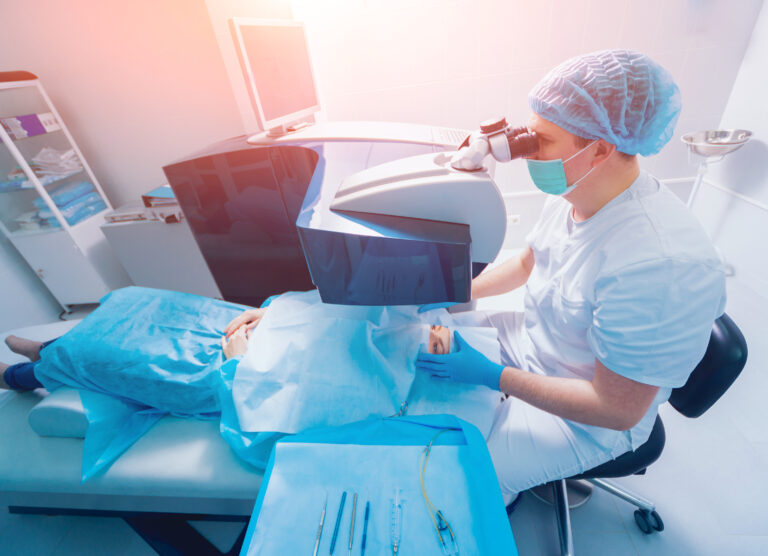
At Netrodaya The Eye City, we didn’t want that gap to exist for our patients. That’s why we invested in both — a dedicated Femto laser for flap creation and the SCHWIND excimer laser for correction — under one roof, performed as one seamless procedure by the same surgical team.
Why Having Both Machines Actually Matters to You
It’s easy for a hospital to say “we have advanced technology.” It’s more useful for you to know exactly what that technology changes about your experience on the table.
- No blade touches your eye, at any point. Because the flap is created by the Femto laser rather than a mechanical blade, the entire procedure becomes genuinely bladeless — reducing the risk of flap irregularities such as uneven thickness, incomplete flaps, or “buttonholes” that can occur with older blade-based methods.
- The flap is more uniform, regardless of your corneal curvature. A blade cuts differently depending on how curved your cornea is. A femtosecond laser doesn’t — it creates a flap of consistent, pre-programmed thickness every time, which is one reason femto-based LASIK has become the preferred standard in modern refractive surgery.
- The correction itself is faster and tracks your eye in real time. The SCHWIND excimer laser is built with high-speed eye-tracking that follows even the smallest involuntary eye movement during the procedure, adjusting the laser firing in real time. Combined with its high repetition rate, the actual corneal reshaping for both eyes is typically completed in a couple of minutes — the eye contact time per eye is often just seconds.
- Less heat, less swelling, more comfort. Because each machine is purpose-built for its one job — rather than one device compromising on both — there’s less thermal stress on the corneal tissue, which generally translates to a calmer, more comfortable recovery.
- It’s touchless and flapless where clinically appropriate. For patients where a fully flapless procedure is more suitable, the same combination of technology also allows for advanced surface-based alternatives — so your treatment plan is chosen for your eyes, not forced to fit whatever single machine a clinic happens to own.
In short: one machine gives you half a modern LASIK. Two, working together, give you the whole thing.
If glasses, contact lenses, and frequent frame adjustments have become a hassle, consider scheduling a LASIK consultation at Netrodaya Eye City. Our specialists will carefully evaluate your eyes and help determine whether Schwind Amaris LASIK or Femto LASIK is better suited to your individual vision needs.
📍 NH2, near Dafi Toll Plaza, Varanasi
📞 +91-7052000601 | 7052525353
Disclaimer: This article is for general informational purposes and does not replace an in-person medical evaluation. LASIK candidacy varies by individual and can only be confirmed after a detailed eye examination.